StarWatch for the greater Lehigh Valley
---------------

DECEMBER  2025

DECEMBER STAR MAP | MOON PHASE CALENDAR | STARWATCH INDEX | NIGHT SKY NOTEBOOK

[Moon Phases]

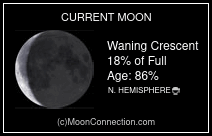
CURRENT MOON PHASE

---------------
1529    DECEMBER 7, 2025:   Geminid Maximum Next Sunday Morning
The Geminids, the most plentiful and reliable meteor shower of the year, reach their broad maximum at 4 a.m. on Sunday, December 14. Under perfect conditions, this shower can produce as many as 150 shooting stars per hour; however, those numbers are drastically reduced to 40 events each hour in the light-drenched suburban areas of the East Coast, including the Lehigh Valley. Reliability over the past several decades has pinpointed peak activity as always occurring between December 13 at 11:00 a.m. and December 14 at 8:00 a.m. This year's 4 a.m. maximum represents the ideal predicted time for making observations since the East Coast will be facing into the Geminid meteoroids. This condition is analogous to the front window of a car or truck plowing through a rainstorm, while the back window remains virtually dry. * Geminids intersect Earth's atmosphere at a speed of 22 miles per second as opposed to the August Perseids which ablate in Earth's lower thermosphere and mesosphere at nearly twice that velocity. Geminids also show a variability in brightness. Shortly after the maximum time more luminous shooting stars are witnessed. With all of these advantages going for the biggest meteor shower of the year, cloudy weather, gusty winds, and wintry temperatures have prevented the Geminids from attaining the same popularity as the August Perseids that can have total hourly rates of 60 meteors from rural locales. * Meteors from an organized shower diverge from a small region of the sky called the radiant. The specks of dislodged cometary dust that become the observed meteors move parallel to each other in an analogous fashion to the sides of a road on a straight section of highway. The thoroughfare diverges from a vanishing point in the distance. In meteor science, this position is known as the radiant. This origin point reaches its highest altitude around 3 a.m., only ten degrees from the zenith, just an hour before the predicted maximum. * Geminids will appear to originate just a few degrees to the northwest of the bright star Castor, the mortal twin of the Gemini brothers. This year, mega bright Jupiter sits just ten degrees to the south of the radiant and will act as an initial focal point to spot the location from where Geminids will be streaming. Go here for a map. * Geminids originate from the debris discarded by the periodic comet-turned-asteroid, 3200 Phaethon, with a 1.4-year orbital cycle around the sun. Comets can suffer numerous fates, such as disintegrating if they come too close to the sun's heat. Also over time, Jupiter and the other gas giants can eject them from the solar system or systematically reduce their elongated orbits until some lose their comet-like identities and become asteroid-behaving objects. * Geminid meteors will be most plentiful during the morning of December 14, but first go outside to find the radiant. Look for Jupiter in the east between 10 p.m. and 1 a.m. It will be the brightest star-like object in the sky. Jupiter's location will be to the right and below Castor and Pollux, the heads of the Gemini twins. The radiant is just to the right of the upper Gemini star, Castor. Position yourself looking at Jupiter to catch the greatest number of Geminid meteors. * Don't forget to check your inventory of heat-retaining clothing and hand warmers as well! I would recommend overdressing, since the cold will most likely be the main culprit that drives you indoors after an hour or two of Geminid watching. * Finally, do not worry about the moon. This year's 27 percent waning crescent in the southeast rises shortly after 2 a.m. and will not affect observations. * Wishing everyone good Geminid hunting under clear skies next Saturday evening into Sunday morning. Ad Astra!

[Geminid Maximum]
A feeble 27 percent waning crescent moon on the morning of December 14 will not reduce Geminid Meteor Shower rates this year. The radiant is represented by the blue "x" in the image. Look for brilliant Jupiter near the location from where the meteors will originate. Graphics by Gary A. Becker using Software Bisque's The Sky.
 

1530    DECEMBER 14, 2025:   Who Were the Magi?
In her book, The Star of the Magi: The Mystery that Heralded the Coming of Christ, New Page Books, 2007 (Amazon, $38.00), astronomer and science historian Courtney Roberts ventures into lesser known Eastern concepts long dominated by Western thought and theological conjecture. She places the Christmas Story's mysterious figures—the Magi and the Star they witnessed firmly within the context of Persian history and Zoroastrian astronomy/astrology. * Roberts constructs a compelling argument that the Wise Men were not kings but more likely Zoroastrian priests from the Parthian (Persian) Empire (247 BCE to 224 CE), rivaling Rome for power in the Near East. The territory under the Parthian rule included present-day Iran and Iraq, spanning into the western regions of Afghanistan, Pakistan, and India. The Magi in the Christmas story most likely lived in what is today northern Iran and acted as advisors to the Parthian kings. Still, the history of Zoroastrian priests dates to the much earlier Achaemenid (Persian) Empire. The journey of the Wise Men was precipitated by a specific Zoroastrian prophecy that a star would herald the birth of a messiah. Earlier Judeans also knew about this messianic vision because of their close relationship with the Persians. * Roberts believes that the Judeans rewrote the history of Israel in their own religious traditions after the Babylonians sacked and burned Israel's First Temple and the city of Jerusalem in 587 or 586 BCE. Judah was the home of the followers of King David of David and Goliath fame. Its population included two of the 12 tribes founded by the 12 sons of the Jewish patriarch, Jacob. In comparison, more prosperous Israel contained the remaining ten tribes that followed the teachings of King Solomon (of King Solomon's Mines fame) who constructed the First Temple in Jerusalem during the 10th century BCE. This Judean influence would also come to dominate Israel and inspire Matthew's Gospel to trace Christ's lineage directly back to the House of David. * When the Babylonian upheavals occurred in 597 BCE and also in 587-586 BCE (Chaldean Dynasty under Nebuchadnezzar II), it was Israel that suffered. This allowed Judean influences to infiltrate into Israel. In the former event, the elite of Israel were exiled to Babylon. In the latter turmoil, Jerusalem and the First Temple were destroyed and more Israelis were forced into Chaldean captivity. Members of the ten tribes remained in custody until 539 BCE when the Babylonians were overthrown by the Persians under the leadership of Cyrus the Great. Cyrus allowed the Israeli captives, now infused with new Eastern ideas, safe passage back to their homeland (many did not return), which by that time was under Judean rule and traditions. * It was the Persians, who aligned themselves with the Judeans, helping to construct the Second Temple in Jerusalem (536-516 BCE), not so much from altruism but from the need to use Jerusalem as a strategic staging area for the Persian conquest of Egypt (525 BCE). * It becomes apparent in Courtney Roberts' narrative that by the time of Christ's birth, Judeans and Israelis looked to the East for inspiration and commonality, rather than to the Western ideals of the Greeks and Romans. * But who were the Magi? They were the wise men, the religious priests of the first Achaemenid Empire and the later Parthian Empire, who in addition were administrators, advisors, doctors, astrologers, and astronomers. They believed in the teachings of the prophet, Zoroaster, who most likely lived in the sixth century BCE and was possibly a near contemporary of Cyrus the Great, the liberator of the Israelites from the Babylonians. The evolution of the monotheistic Zoroastrian religious beliefs included God and the Devil, Heaven and Hell, the Last Judgment, the Resurrection of the Dead, Angels and Demons, the Virgin Birth of a Savior, and the Ultimate Battle between Good and Evil (Roberts, p. 67). Sound familiar…? Judaism, Christianity, and Islam have many tenets of Zoroastrianism embedded within their worldviews. * Next week, I will discuss the astronomy behind the Star that heralded the birth of Christ. Ad Astra!
 

1531    DECEMBER 21, 2025:   What was the Star of the Magi?
What was the Star of Bethlehem? Astronomers have considered planets, comets, supernovas, bright meteors, and even auroras. Many historians feel that the Star was seen between 7 and 6 BCE and linked to a rare triple conjunction (coming together) of Jupiter and Saturn. It started with faster moving Jupiter overtaking Saturn in the spring of 7 BCE. By summer Jupiter had stopped its eastward motion and moved backwards, or retrograded, to pass Saturn for a second time. Finally in the fall of 7 BCE, Jupiter, moving eastward again, overtook Saturn for a third time. In early 6 BCE, Mars joined Jupiter and Saturn. * We see retrograde motion almost every day, when a slower moving car passes a faster moving one, but 2000 years ago, it was one of the major astronomical problems that needed understanding. The slower car appears to move backwards relative to the driver and passengers of the more rapidly moving vehicle. The retrograde motion of Jupiter (and Saturn) was the result of the faster moving Earth passing Jupiter and Saturn in Earth’s yearly trek around the sun. Because Jupiter is closer to the Sun, its retrograde loop is much larger than Saturn's retrograde dance. During retrograde motion, this allowed Jupiter to catch up and pass Saturn for a second time while both planets moved westward, and then pass Saturn for a third time when each planet began its normal eastward movement in the sky. In early 6 BC, Mars joined the pair to form a loose grouping low in the west during evening twilight. * The interpretation by the Zoroastrian Magi of these events was even more interesting to Western historians. The king of the astrological gods, Jupiter, thrice passed Saturn, the protectorate of the Jewish people, in the constellation of Pisces which to the Magi aligned with the Hebrews. Herod's court never saw the star foretold by the Zoroastrian (Persian) prophecy that prompted the interest of the Wise Men who most probably began their journey in early 6 BCE. Herod was not even Jewish, and he was despised by the people over whom he ruled. * Validating the Star and the search of the Wise Men associated with Christ's birth is what Courtney Roberts sought to show through a thorough investigation of mainly Persian historical records in her book, The Star of the Magi: The Mystery that Heralded the Coming of Christ, New Page Books, 2007 (Amazon, $38.00). To Roberts' credit, she admits she was unable definitively to solve the mystery that the Star was a key factor in the announcing of Christ' birth. That it prompted the quest of the Magi to Judea may never have happened, and Matthew's Gospel, which chronicles these events, may have been an embellishment, simply a good story to which Jews could relate. I credit Roberts' investigation with merely sticking to the facts, with no embellishments, to persuade her reading audience about the Star and the journey of the Magi. * In the past the Persians had been in alliance with the Judeans. Persia had spearheaded the construction of the Second Temple, so the Judeans had no animosity with Eastern Philosophy as they did with the Western ideas of the Greeks and Romans. * The Persian priests who followed the teachings of Zoroaster were fascinated by conjunctions of Jupiter and Saturn that occurred at the borders between different zodiacal signs. To them this signaled a change in the world order. Triple conjunctions did not seem as important. The Magi also believed in an early prophecy regarding the birth of a messiah, but one that would unite all peoples and all religions into a new all-encompassing belief. * I still believe the triple conjunction of Jupiter and Saturn starting in 7 BCE, ending in the spring of 6 BCE, best represents the Star, despite a lack of textual proof other than the Gospel of Matthew. Matthew would have certainly known about this Persian tradition of Jupiter-Saturn conjunctions. The event also fits neatly into the time frame of Augustus' second census/taxation decree of 8 BCE and Herod's death in the spring of 4 BCE, the latter chronicled by Josephus, a Jewish historian of that era. I just wish that CNN or MS NOW had been present with all its reporters and video equipment to archive accurately this Breaking News story for all future generations to enjoy. Happy Holidays to everyone and a blessed Christmas to all who celebrate! Ad Astra!
 

1532    DECEMBER 28, 2025:   A Good Year for the Ursids
This StarWatch is being brought to you early. Unbearable might be the best way to describe this cold-weather meteor event, which occurs during the busiest and cloudiest time of the year and cannot be seen from warmer Southern Hemisphere climes. It is also following the euphoria of the most active annual meteor shower, the Geminids, just slightly over one week before the Ursid activity peaks. Ursid meteors will fly from December 17 through the 27th. According to the International Meteor Organization, activity will peak on the morning of December 22 at 5 a.m. EST. You cannot get a better time than that for East Coast observers because this area of the world will be plowing into Ursid activity like the front windshield of an automobile moving through a rainstorm. Usually, this amounts to no more than a half dozen to ten meteors per hour for the Ursids; however, as with most events, rates can vary depending on whether the Earth passes through a single or multiple threads of denser meteoroid debris. Such an encounter is predicted at approximately 12:30 a.m. on the 22nd. Enhanced activity was expected in 2023, but did not materialize; however, higher than average hourly counts were noted in 2006 through 2008 and in 2014, 2015, 2017, and 2020. * Meteor showers owe their existence to the dross released from active comets orbiting the sun or comets that have settled into retirement within the asteroid belt. Comet 8P/Tuttle, the progenitor of the Ursids, was discovered on January 5, 1858, by Horace Parnell Tuttle (1837-1923), an American astronomer and Civil War veteran. * Comet Tuttle is periodic with a 13.6-year orbital cycle that last reached perihelion, its closest position to the sun, on August 27, 2021. * If you are going to observe the Ursids, be outside just after midnight on the morning of December 22 when the predicted filament is encountered from a previous orbital pass. Meteors will appear to diverge from near the bowl of the Little Dipper (body of the Little Bear, Ursa Minor) which will be about 25 degrees above the northern horizon during the early evening hours of December 21 and rise to about 52 degrees by 6 a.m. on the 22nd. The North Star is located at the end of the handle of the Little Dipper. Focus your attention above that area, near the zenith, where the sky will be at its darkest, allowing more meteors to be witnessed. Moonlight will not affect Ursid activity this year. Luna sets around 7 p.m. on the 21st and will not affect meteor rates. * The most significant factor in making any winter observations of shooting stars is staying warm. Layer up and say a prayer for a warmer, clearer evening than the ones we have had during this much colder than average December. Good Ursid (Little Bear) hunting to all. Below is a sky map showing the Ursid radiant, the location from where the meteors will be streaming. It is highest in the sky towards dawn. Ad Astra!

[Ursid Meteor Shower Radiant]
Map designed by Gary A. Becker using Software Bisque's The Sky...
 

[December Star Map]

[December Moon Phase Calendar]
 

---------------