![[Moon Phases]](../moonphases/2024-07-phases.jpg) |
|---|
 |
 |

 JULY 7, 2024: Running with the Moon/Spectacular Spica Occultation
Friday, July 5: The moon enters its new phase at 6:58 p.m., when it is completely invisible to the naked eye as it aligns between the Earth and the sun. New moons, such as this one, are a rare sight, only becoming visible during a solar eclipse. It's worth noting that Earth is at its farthest point from the sun, known as aphelion, at 1:06 a.m. EDT on the same day. Earth's orbital speed is slowest at aphelion.
Sunday, July 7: This is the perfect opportunity to spot Mercury. A slender, five percent sunlit, moon hovers directly above Mercury in the dusk, WNW sky. Their separation is a mere three degrees. To make the most of this observation, start your sky watching 30 minutes after sundown in a location with a clear western horizon. Both Mercury and the moon will be six and nine degrees above the horizon, respectively. Binoculars are highly recommended to enhance your viewing experience.
Tuesday, July 9: Identify Regulus. An hour after sunset, observe the 16 percent lit, waxing crescent moon above and to the left of Regulus, the brightest star of Leo the Lion. Regulus and the moon are positioned 12 and 16 degrees above the western horizon. Binoculars will help to make Regulus easier to view.
Saturday, July 13: Moon Occults Spica. The moon is at first quarter at 6:49 p.m., half lit and half in its own shadow. Its terminator where the sun is rising appears as a straight line. Observe the moon with binoculars at 10 p.m., and you will see the blue supergiant, Spica, just off to the moon's left. By 11 p.m., the leading dark limb of the moon has moved to within 10 minutes of arc or 1/6th degree from Spica. The moon is 1/2-degree in angular diameter. Between 11:26 and 11:27 p.m. (11:26-25), according to my computer program, the moon occults the blue supergiant. This observation needs to be made with a telescope or binoculars because the nearly 27,000-time brightness difference between the moon and first magnitude Spica will overwhelm the eye, making Spica impossible to observe without optical aid. At the time of the occultation, the moon will only be nine degrees above the WSW horizon, adding another challenge for a successful observation. Luna sets before Spica emerges against its sunlit limb.
Wednesday, July 17: Moon near Antares. About an hour after sundown due south, check on the bright waxing gibbous moon. Luna will only be three degrees to the left of the first magnitude, red supergiant star, Antares. Like Spica a few days before, you will need binoculars to witness easily the rival of Ares in the sky. Ares is Greek for Mars. Make sure that trees are not blocking your view because the moon will only be only 21 degrees above the horizon, about as low as Luna can go for its highest altitude, which for the Lehigh Valley always occurs when a celestial object is due south.
Sunday, July 21: The moon is full at 6:19 a.m. It sets in the SW at 5:36 a.m., just as the sun rises. This is exactly what full moons do because they are opposite to the sun.
Ad Astra!
JULY 14, 2024: Spica Occultation Season is Here
![[Spica and the Moon]](7-24-spica-and-moon.png) |
|---|
| This computer simulation will give potential observers an idea of how the occultation of Spica by the moon will look on July 13. The approximate time is 11:26 p.m., EDT. Spica will look like a point source not an extended object as shown in the drawing. Keep in mind that the moon will only be nine degrees off the WSW horizon when the occultation takes place. Gary A. Becker graphics using Stellarium... |
![[Spica and the Moon]](7-24-spica-occultations.png) |
|---|
| Gary A. Becker graphics... |
JULY 21, 2024: Waning Moon Mingles with the Planets
Sunday, July 21: Moon Near Pluto. The moon is full at 6:19 a.m. It sets in the SW at 5:36 a.m., just as the sun rises. This is precisely what full moons do because they are opposite to the sun. At 4 a.m., Luna is only 11 degrees above the SW horizon. The dwarf planet Pluto sits four and one-half degrees above the moon. Only a good star chart and a large telescope will reveal its presence.
Wednesday/Thursday, July 24/25: Moon Near Saturn. The moon travels across the triangular-shaped Sea Goat, Capricornus, and into Aquarius, the Water Bearer, to be close to Saturn on both mornings. This proximity, coupled with the absence of stars brighter than Saturn in these constellations, makes observing this event easy. On the 24th, the moon is positioned below and to the right of Saturn; the following morning, it is above and to the left of the ringed world. Only 20 degrees above the horizon under the moon is Saturn's only rival in brightness, lonely Fomalhaut of the star pattern, Piscis Austrinus the Southern Fish. Except for Fomalhaut, that constellation is also awash in faint stars and too near the horizon for easy observation.
Thursday, July 25: Moon Near Neptune. Four degrees (eight lunar diameters) to the moon's left lies the Roman god of the oceans, Neptune. Ten x 50 binoculars should reveal it, but shift Luna from the field of view. Neptune has a bluish hue in larger telescopes that will not be revealed through binoculars.
Monday, July 29: Moon Occults Star is near Uranus/Pleiades. HIP 15110, (Hipparcos Star Catalog), a 4.9 magnitude luminary, is hidden on the sunlit side of the fat, waning crescent moon at 2:33 a.m. The star emerges from the shadowed portion of the moon 54 minutes later at 3:27 a.m. The moon is 5.5 degrees above Uranus and eight degrees from the Pleiades near the Taurus-Aries border. Binoculars will be needed.
Tuesday, July 30: Moon Near Pleiades/Mars/Jupiter. The 26 percent lit, waning crescent moon is below the Pleiades. Four degrees below and to the right of the moon lies Mars, the ruddy god of war, shining at first magnitude (0.9). Six degrees below Mars will be first magnitude Aldebaran (0.9 mag.), the amber eye of Taurus the Bull. Six degrees to Aldebaran's left will be brilliant Jupiter, reflecting the sun's light at magnitude -2.2. Remember that the brighter the celestial object, the more negative its magnitude. Binoculars are always a help, but even the Pleiades should be visible with just the unaided eye.
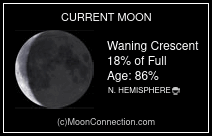
Wednesday, July 31: Moon left of Jupiter. The 18 percent sunlit moon is positioned 7.5 degrees to the left of Jupiter and three degrees from 1.7 magnitude Elnath, the tip of the lower horn of a rising Taurus the Bull. Luna is 21 degrees above the ENE horizon at 4 a.m.
Thursday/Friday, August 1 and 2: Waning Moon. Luna is 32 degrees above the ENE horizon on the 1st and 12 degrees on the 2nd. Make both observations at 5:00 a.m. The sun rises at 6:00 a.m., making the observation time critical to success.
Sunday, August 4: The New Moon occurs at 7:13 a.m. and will remain difficult to observe until the 6th.
Ad Astra!
JULY 28, 2024: Meteor Rates on the Upswing/Spica Occultation
Spica Occultation A Success: Saturday evening, July 13, was a mostly clear but muggy night. Spica was an easy target through binoculars, but I could not see it without optical aid 90 minutes before the occultation of the 16th brightest star of the night. Through binoculars, the unlit portion of the moon was still illuminated by weak earthshine, the reflected sunlight from Earth reflected back from the moon, making it possible to witness the dark limb of Luna approaching the star. Still, when the star blinked out, I was surprised, requiring about two seconds to realize it was gone, then another two seconds to focus on the atomic time "ticking" away on my smartphone resting on the sidewalk. My estimate of when the occultation occurred was 11:23-50 p.m. EDT, one minute and 36 seconds earlier than my computer prediction. As my wife, Susan, has continually told me, "Never trust technology." Ad Astra!
![[Late July Meteor Showers]]( 7-24-late-july-meteors.png) |
|---|
| Southern Delta Aquariid and Capricornid meteors which can be seen now are a good prequel to the Perseid Meteor Shower which will be most active on the morning of August 12. Observe after midnight. Gary A. Becker graphics... |
![[July Star Map]](7-24-stars.png) |
![[July Moon Phase Calendar]](7-24-moon.jpg) |