 |
|

-
1472
 NOVEMBER 3, 2024: Land of the Dancing Lights
-
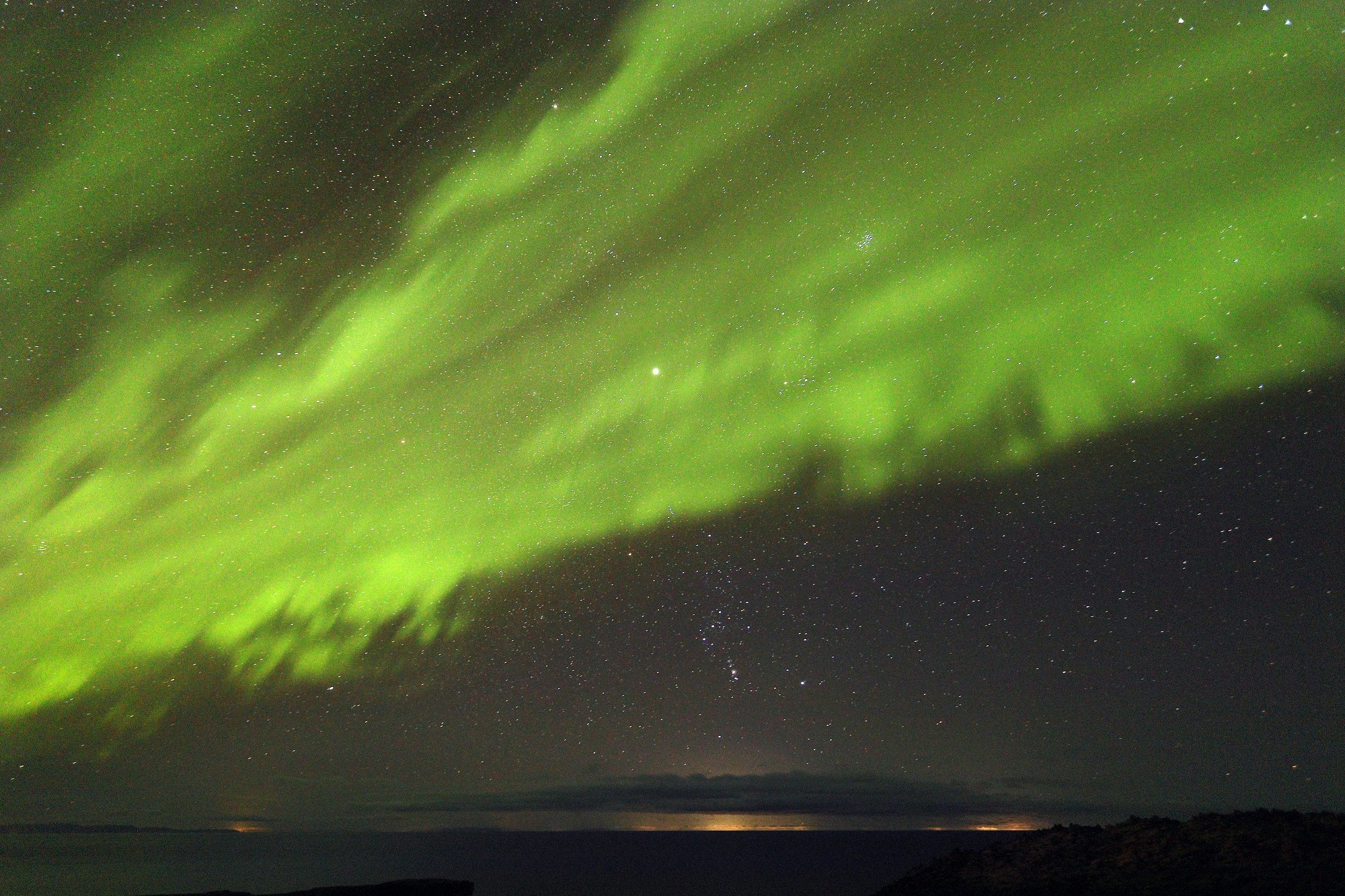
I have always wanted to visit Iceland to see a country where volcanoes and the northern lights reign supreme. It's also where you can place one leg on the Eurasian Plate and the other on the North American Plate and hope they suddenly don't lurch sideways dropping you 10 feet at that exact moment. * As an astronomy educator, however, Iceland is located directly under the auroral oval where even on a quiet night, a thin strip of fluorescing green atmospheric oxygen undulates slowly across the zenith in a never-ending display of Earth's magnetic field successfully shielding us from the sun's dangerous outpouring of deadly charged solar wind particles. We wouldn't be here without geomagnetism, or at best, we would be living underground. * However, Iceland's far northern latitude, like all other regions where enthusiasts travel to witness the northern lights, such as Norway, Sweden, Finland, Canada, and Alaska, segregate the auroral viewing season from the warmer periods of the year. That's because in the summer, when conditions are most temperate, it never gets dark enough to see auroras in these locales. * Then there is the weather, which in northern climes is mostly cloudy, cold, drizzly, and damp, often with blustery conditions where trees that buffer the wind are scarce or nonexistent. * So I came to Iceland, to Arnarstapi on the Vesturland Peninsula at 64.8-degrees north latitude, overlooking the Faxafloi Sea (North Atlantic) about 131 miles south of the Arctic Circle with little expectation of seeing a vibrant display, not only because of weather conditions, but because the space weather environment must also be active. * Had it not been for my bald, quirky traveling companion, Peter Detterline, I would have probably stayed at home. Pete told me to write that as his introduction. We have been good friends ever since I was his cooperating teacher in the spring of 1981. Since our retirements, we have racked up an impressive 100,000 miles of traveling experiences, all wonderful. Pete is also an excellent cook. We had planned this trip in the early spring of this year. * Yes, Iceland produced the rain, drizzle, fog, wind, and everything in between, but on our first night in Arnarstapi, the skies miraculously and unexpectedly cleared. The prediction for auroral activity was also the best that night for several weeks into the future. When Pete came inside around 9 p.m., jumping up and down, I knew that either the world was ending or the night would be special. Thankfully, it was the latter, an incredible auroral experience. * Upon exiting our house with no dark adaptation, I witnessed a thick ribbon of green straddling the sky, slowly wavering as expected in what I interpreted as an average display. However, as the minutes passed and my eyes kicked into dark mode, the ribbon expanded into a wider band of greenish activity. Sadly about two hours later, clouds moved in, veiling an increasingly active spectacle, but they too dissipated shortly after midnight, allowing the sky to be completely engulfed in regions of auroral activity, from hazy patches of diffused light, brilliant ropelike streamers spanning the heavens, as well as sharp, narrow dagger-like spikes of raining solar debris lighting the upper atmosphere in reds and the lower levels in greens as captured by our cameras and video equipment. Auroral bursts rained down upon us from the zenith, flowering outward like wiggling swords as they approached. By 4:30 a.m., I needed to get to bed, but Pete hung around until dawn began to erode the night's diminishing activity. No, our experience was not as spectacular as the May 10/11 display of this year, which was locally obscured by clouds until an hour before dawn, but it was a night of intense activity in a land of fire and ice, auroral fire this time. Click on the image below to go to my astrophotography page to see images of my Icelandic adventures with Peter Detterline and plenty of auroral images. Unfortunately, the videos will not play because the slides are in PDF format. Ad Astra!
| |
1473
NOVEMBER 10, 2024: Iceland's Weather Surprises
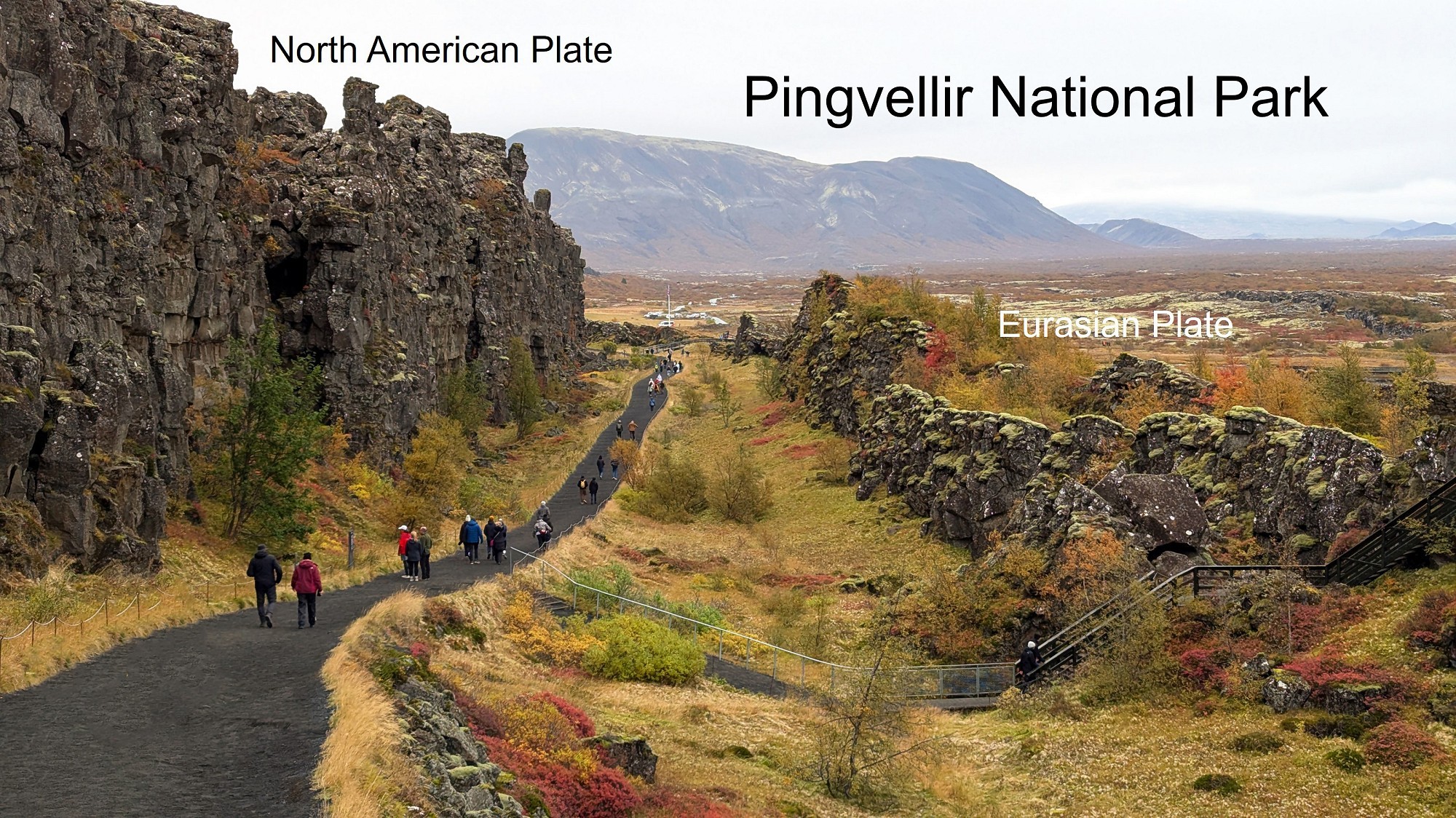
It was drizzling when Peter Detterline and I arrived at Iceland's Keflavik International Airport. The entire flight had been somewhat disappointing because we had window seats that would allow us to observe the northern lights from about six miles above the Earth's surface. However from our vantage point, clouds or perhaps jet contrails seemed to be present during most of the trip. Somewhere between landing and clearing customs, Pete showed me the weather forecast for Fairbanks, Alaska, one of the areas we had seriously considered for our auroral adventure. Big, yellow, smiling suns for five days in a row, but with temperatures in the single digits during the entire stretch. "Burr," I thought, "but at least we'd have clear nights." * Years ago, I remember talking to a woman in Fairbanks who had braved the late January 1989 cold snap that recorded a record low temperature of minus 76 degrees F. for the city. She recounted taking a pot of hot coffee and throwing its contents off the second-floor balcony of her apartment. The warm liquid leaving the pot hit the ground frozen. * Here in Iceland, 3100 miles to the east of Fairbanks, surrounded by the moderating Atlantic Ocean, the high 30s were the lowest temperatures to be expected for a clear night. But our three-day forecast produced by Iceland's Meteorological Office showed primarily cloudy conditions with periods of drizzle in the areas that we would be visiting, including part of a five-day stay in a rental home in Arnarstapi on the Vesturland Peninsula about 65 miles northwest of Reykjavik across the Faxafloi Sea. I remember thinking, "What a bummer for astronomy." Thank goodness, I like volcanoes, shifting tectonic plates, mild earthquakes, and geysers. Iceland has them all, and I might have to make do with another interest, geology, on this field experience. * So in the afternoon, after grabbing a late morning breakfast in a suburban Reykjavik Kaffee Haus, we headed for Pingvellir National Park, where we did get to walk in drizzly conditions along the Mid-Atlantic Ridge with the North American Plate to my left and the Eurasian Plate on my right, a bucket list experience for me, indeed. That night in our motel near Fosstun, it poured. However, the next morning after breakfast, which included, in addition to eggs and bread, cheeses, meats, and vegetables, weather conditions improved steadily as we made our way among several stops to Arnarstapi, arriving to our amazement and excitement, under a nearly cloudless sky. We observed virtually all night. That was the first of several weather surprises we encountered. * Deteriorating conditions the following day, followed by two days of rain and mist, allowed us the needed time to rest and to begin grappling with our photography, as well as to pick up copious supplies in Olafsvik, to walk a black sand beach, to hike along coastal lava fields, to tour magnificent Vatnshellir lava cave, to climb a volcano in gale force winds, and to take a drive completely around the peninsula, visiting the small town of Stykkisholmur, where Pete and I each broke our latitude record, reaching 65 degrees, 5 minutes north. During the next three days and two nights that we remained in Iceland, we were treated to cloudless skies with pleasantly warm days and clear nights, allowing us completely unobstructed views of the northern lights. We were fortunate, perhaps even lucky, in a land where cold, damp, drizzle, and rain are the general bywords, and the locals say the weather changes every 10 minutes! More about my experiences in sunny Iceland next week. Click on the picture below if you missed them last week. Ad Astra!
| |
-
1474
NOVEMBER 17, 2024: "They Paved Paradise and Put Up a Parking Lot"
-
Peter Detterline posed a question during our trip to Iceland. "If you lived here, with the northern lights visible every clear night, would you get tired of them?" My answer was a definitive "yes." Too much of anything seems to numb the soul for more of the same. However, three great nights of aurora watching have not been nearly enough to dampen my enthusiasm for wanting to see more. * I remember teaching an Allen student who had moved to the Lehigh Valley from Alaska. He told me his mother, who enjoyed photographing the northern lights, was distraught over her decision to discard boxes of auroral photos when she chose to live in Pennsylvania. According to the student, she thought that she would simply take up her hobby in a new location. * "Don't it always seem to go that you don't know what you've got 'till it's gone. They paved paradise and put up a parking lot," according to "Big Yellow Taxi," a song recorded by Canadian singer-songwriter Joni Mitchell in 1970. Iceland will have several more years of active auroral displays before conditions quiet down as the sun approaches solar minimum in the early 2030s. * Aurora night two occurred during our fifth and last evening in our Arnarstapi rental home. It was less spectacular than our first encounter, yet nonetheless still captivating. I spent a good chunk of it trying to stay balanced in an 8000-year-old lava field, tamed by a thick carpet of soft, spongy moss that was an iridescent green by day. In the immediate foreground about one mile distant, was the local volcano, 1727-foot Stapafell. When the aurora brightened, cloud-draped Snaefellsjokull, the volcano Jules Verne used to transport his fictional characters to Earth's center, was visible five miles away. On this night, the display was more curtain-like, with at times, vivid green furls waving slowly back and forth like a flag in a gentle summer breeze. I also had a better look at the sky with Polaris displaced to a staggering 65-degree altitude, almost too high to maintain one's steadiness in the irregular lava field terrain. Orion rose glacially over the Atlantic around 11 p.m., its belt reaching an altitude of only 25 degrees by my 2 a.m. bedtime. * Our last full day in Iceland was spent slowly making our way to our next lodging, Bru Country Estate, near the Mid-Atlantic Ridge where we had started our Icelandic journey just one week earlier. Among at least a half dozen stops for photography, we discovered Lake Apavatn with plenty of shoreline room available for late-night astrophotography. * We settled into our room and participated in a sumptuous dinner buffet that included lamb and mushroom soup, two foods I don't particularly like, but were finely prepared and consumed with enthusiasm. After dinner, we then got our gear together, suited up in warmer clothing, and drove back to the lake. * Oh my goodness, it was filled with dozens of auroral tour vans and perhaps a hundred people milling about with distracting flashlights in a muffled carnival-type atmosphere. I assembled my camera and tripod in the dark, accidentally flipping the tripod over with the camera and lens attached when I gathered the strap attached to its storage case. I can still see it happening in slow motion, falling backward to the macadamed parking lot. Somehow, the camera body survived its hard impact with minimal scars, but the lens did not. It has been repaired since my return. * I photographed the sky on night three exclusively with my fisheye lens among a decreasing number of enthusiasts during the next few hours. By midnight, Pete and I were alone, with the wavering green and red lights of the north reflecting off the choppy waters of the wind-scoured lake. * It was homeward bound the following afternoon across a cloudless Greenland, landing in Newark around 7 p.m. Iceland is certainly a country worthy of another visit. Ad Astra!
|
Moonrise on November 15... Gary A. Becker image...
|
-
1475
NOVEMBER 24, 2024: Asterisms: Constellation Wannabes
-
I have had a great deal of fun asking my students the name of a constellation that includes seven well-known stars that we informally call the Big Dipper. They almost never get it correct. In reality these seven luminaries are the most visible part of the Big Bear, Ursa Major, while the Little Dipper, known officially as Ursa Minor, is composed of the same stars as the Little Bear. It surprises my learners that this iconic symbol of the heavens is not a constellation. * For Americans the Big Dipper is a nationally significant group of stars that most likely dates back to the Drinking Gourd of the pre-Civil War era; however, in different nations and ethnicities, its seven stars represent a plow (England), a steel pan (Netherlands), a wagon (Germany), a sail (Saudi Arabia), the Northern Dipper (China), Bishamon, the god of war (Japan), and Saptarishi, the Seven Sages in Hindu mythology (India). * When representatives of the International Astronomical Union agreed in 1922 on a list of 88 constellation boundaries covering the entire sky, their delegates fell back to the Greco-Roman figure of the Great Bear. Nationalism was not a factor in their decision-making. Most Native American tribes also saw a bear figure in the heavens. * When I traveled to Iceland, I brought a copy of the asterisms listed in Donald H. Menzel's A Field Guide to the Stars and Planets. It was the first astronomy book purchased with my own funds, most likely in 1965 from a bookseller (Bachman's?) on Hamilton Street in Allentown. Its $4.95 cover price resulted from the accumulation of several months of allowance payments because at that time my weekly stipend was only 50 cents. Of course in the mid-sixties, gas prices were half that amount per gallon, and you could spend all day at the movies for only a dollar. I'm assuming my parents wanted me to make prudent decisions about the money that I spent. * I still use Menzel's book today because of its copious number of tables in the back, which often spur ideas for these blogs. One of those lists encompasses constellation wannabes, or asterisms, groupings of stars not officially sanctioned by the International Astronomical Union but recognized by name through national or cultural affiliations. I thought it might be fun to illustrate Menzel's list for others to view or to find in the sky if time permits. The maps you will discover below include most of the heavens currently visible at 6:00 p.m., just after dark. If the asterism is part of a constellation, it is denoted in lavender; if it is a standalone, blue. One map hypes the eastern sky, while the other concentrates on its western counterpart. I have also included some asterisms not described in Menzel's tabulations, including one of my inventions. It is identified. If you plan to hunt them down right after dark, start with the western sky because these asterisms will set before the rising asterisms in the east. If you want to see all of them, a rural, moonless sky or the use of binoculars will be necessary, but most can be spotted from suburbia if your eyes are adequately dark-adapted. Good asterism hunting, or simply check them out on the maps. Ad Astra!
|
Asterisms visible in the eastern sky at 6 p.m. Graphics by Gary A. Becker using Software Bisque's The Sky.
|
|
Asterisms visible in the western sky at 6 p.m. Graphics by Gary A. Becker using Software Bisque's The Sky.
|
|
Asterisms visible in late autumn at 6 p.m. Graphics by Gary A. Becker using Software Bisque's The Sky.
|
|
This volcanic eruption near Iceland's famous Blue Lagoon began at 11.14 p.m. on Wednesday evening November 20, in the Sundhnuks craters. Some of the lava flowed downslope along a barrier towards the Blue Lagoon, a famous tourist spa. It inundated the back portion of the lot where our rental car was parked just five weeks earlier. In the photo below, the dip in the barrier was the exit towards the parking lot, less than 1000 feet from where I was standing on October 12. Weather and topography change quickly in Iceland. The top photo was from Iceland's Meteorological Office; bottom, Gary A. Becker.
|

| 

![[Moon Phases]](../moonphases/2024-11-phases.jpg)
![[Asterisms in the East]](11-24-moonrise-over-coopersburg.jpg)
![[Asterisms in the East]](11-24-asterisms-east.png)
![[Asterisms in the West]](11-24-asterisms-west.png)
![[Asterisms of late Fall]](11-24-asterisms-of-fall.png)
![[Iceland's Latest Volcanic Eruption]](11-24-iceland-volcano.jpg)
![[The Blue Lagoon Minus Brooke Shields]](11-24-blue-lagoon.jpg)
![[November Star Map]](11-24-stars.png)
![[November Moon Phase Calendar]](11-24-moon.jpg)