StarWatch for the greater Lehigh Valley
---------------

OCTOBER  2025

OCTOBER STAR MAP | MOON PHASE CALENDAR | STARWATCH INDEX | NIGHT SKY NOTEBOOK

[Moon Phases]

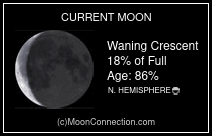
CURRENT MOON PHASE

---------------
1520    OCTOBER 5, 2025:   Binoculars for Christmas
When my parents realized that they might have a slightly different child on their hands, one who was not into sports or popularity, but instead focused more on looking at the night sky, they tried to nurture my interests by purchasing a telescope for my 11th or 12th birthday. It was a retractable spyglass refractor, similar to what a naval officer might have used in the eighteenth century for spotting enemy ships at sea. * My first telescope worked probably just as well as those original scopes. A ringed holder, that my father devised, attached to a tripod, and I received the means to explore the universe from the small backyard of my Allentown home. * However, frustration might be the best description of my developing attitude as I tried to use that scope. Navigating the universe became more like, "Could I find that darn star and focus it properly before my neck collapsed." After the initial excitement wore off, that little telescope found a new home in my closet. * I did have better results with my grandfather's 7x50 binoculars as I reclined outside at night on a cushioned chaise lounge, while viewing the heavens. The binoculars were easy to focus, and when I pointed them at a star or an undiscovered area of the heavens, I had a reasonable chance of finding what I was trying to observe. Those binoculars were a significant catalyst for an enhanced enjoyment of sky watching and an increased desire to make it a hobby, and eventually a career. * Here is my advice if you, or someone you know, is just getting into astronomy or birding and wants to take the next step. Buy binoculars for yourself or for them as a Christmas gift. You can spend six or seven thousand dollars to own the very best or just several hundred dollars to obtain a more than adequate pair. Here are some concepts to consider. * Decide whether you want a roof prism or a Porro prism design. Binoculars using roof prisms are bulkier, slightly heavier, but less expensive, while binoculars that utilize a Porro prism are more compact, lighter in weight, and sleeker in appearance. Below is a photo to distinguish the two designs. Both will give you a normal image, where up and down, right and left remain the same as the view you are trying to magnify. * Keep the magnification low. Don't go over 10 power. My grandfather's 7x50 pair had a magnification of seven times with a lens diameter of 50 millimeters. All binoculars are marketed in the same fashion. The higher the magnification, the more difficult it will be to steady the image. If your binoculars are magnifying 20 times, any movement you make will be enhanced by the same amount. For size and weight comfort, I would not exceed an aperture of 60mm. * For astronomical purposes, have a reasonable exit pupil of between five and seven millimeters. The exit pupil represents the diameter of the light cone created by the binoculars entering the eye. Since the fully dark-adapted eye in a young adult can reach 7 millimeters, any larger exit pupil creates wasted aperture, resulting in wasted light. Obtain the exit pupil by dividing the magnification by the aperture, 7 into 50mm, which for my grandfather's binoculars equaled 7.1mm. All binoculars work in the same manner. Exit pupil becomes less important with age because the eye loses its ability to reach full aperture. * Finally, consider the eye relief of the binoculars. This is the distance that light must travel after exiting the last lens of the eyepiece before entering the eye. Eye relief becomes very important if you wear glasses because the binocular eyepiece does not rest against the eye socket. If you want to view the entire field that the binoculars are producing, the whole cone of light must enter the eye. Some binoculars get around this by having diopter corrections built into a rotating eyepiece to create a focused view without wearing glasses. These work well if you have minor eye corrections of a few diopters, but then the rest of the world around you becomes fuzzy. For me, a lifelong wearer of glasses, 17-20mm works best. * There are many variables to consider when purchasing binoculars, but my recommendation would be to start with combinations of 7x35, 7x50, 8x42, 9x60, or 10x50 units. I own 8x42 and 10x50 binoculars. Also, keep in mind that binoculars have a much greater utilitarian purpose than just viewing the stars. They are great for terrestrial observations as well! Ad Astra!

[Roof vs. Porro Prism Binoculars]
 

1521    OCTOBER 12, 2025:   Three Words Misunderstood
I began my enjoyment of astronomy on a shoestring budget, so a good telescope was out of the question. For my 11th or 12th birthday, my parents bought me a spyglass telescope with a singlet, a single lens element that produced an image of Saturn with one side of the rings a vibrant red and the other a deep blue, a sure sign of a severe optical defect called chromatic (color) aberration. I knew nothing about this problem and thought how "cool" it was that Saturn would have these two wonderful colors associated with it. * Even with a makeshift holder that my dad had designed, the small, unsteady tripod to which the holder was attached made finding objects a real challenge. So the little telescope with its colorful prismatic lens went mostly unused. I resorted to observing the sky visually through my grandfather's binoculars. * For my 16th birthday, I received an Edmund Scientific 8-inch mirror grinding kit and went to work for the next 18 months sculpting the main mirror for a reflecting telescope. With the help of master optician, Paul Shenkle, who worked for the crème de la crème of telescope manufacturers, Questar, near New Hope, PA, and my father's mechanical skills, a truly fine instrument emerged. My new telescope with its (Mike) Spacek Mount saw its first light on my high school graduation night, June 9, 1968, when the nearly full moon skimmed under the bright red giant, Antares, the heart of Scorpius the Scorpion. The next day was my 18th birthday. * However, not having had a working telescope until the cusp of college, my focus remained fixed on the macro sky. I looked at the big picture rather than the micro sky, what could be revealed through an eyepiece of a telescope. * Meteor observing catalyzed my burgeoning interest in astronomy, and poring through numerous books that I had in my small but growing library, I became acquainted with three words, two that were misused continuously by both amateur and professional astronomers alike. They were a meteor, a meteoroid, and a meteorite. * A meteor is the flash of light created by a meteoroid slamming into the Earth's tenuous atmosphere at speeds that can approach 30 miles per second. These small dust particles excite and ionize a tube of air through which they pass, causing the air to glow. The heating of the atmosphere by the vaporized meteoroid excites electrons in atoms and molecules of mostly nitrogen and oxygen at altitudes of 50 to 75 miles. Outer electrons jump away from the nuclei of the atoms gaining energy in distinct increments or become completely detached (ionized). In the blink of an eye, electrons reattach themselves to other atoms, descending the energy ladder in no particular order. Some of the transitions release visible light, which creates the meteor phenomenon. Meteors are born from meteoroids, the dross (dust) from comets when they are near the sun. Comets lose these small particles as the ices, from which they are embedded, vaporize (sublimates) from the sun's heat. * A meteorite is created from a much larger meteoroid (or asteroid) that makes it to Earth's surface. These particles are not born from comets, but rather from the asteroid belt, larger bodies, mainly between Mars and Jupiter, broken apart through past collisions. They enter the Earth's atmosphere and make it to the surface producing spectacular fireballs as they decelerate and often detonate in the atmosphere. Meteoroids released from comets never become meteorites. They are too small and fragile. * The reason for this misconception may stem from Meteor Crater near Winslow, Arizona, created about 49,000 years ago by a meteorite that was 100-160 feet across. Listen closely next time a professional astronomer talks about a "meteor striking the Earth" and understand that they should be referring to a meteorite. Ad Astra!
 

1522    OCTOBER 19, 2025:   Orionids Fly during the New Moon
The Orionid Meteor Shower, one of the top five shooting star events of the year, is predicted by the International Meteor Organization to be at a broad maximum on Monday and Tuesday mornings, October 20 and 21. Fifteen to 20 meteors per hour are expected from this annual event several hours before dawn. This time also coincides with the night of the new moon on October 21. * Enthusiasts can begin detecting Orionid meteor activity as early as October 2 and as late as November 7; however, it is the few mornings surrounding the maximum date that should produce the highest rates. * Do not watch right after dark. The radiant, the location in the sky where meteors will seem to diverge, does not rise until 11 p.m. for mid-latitude sky watchers. This place is near the elbow of Orion's arm, holding his club as he fights Taurus the Bull. See the location of the radiant here. Looking for Orionids earlier than 11 p.m. might allow views of meteors grazing Earth's upper atmosphere and passing back into space, but this time frame will also provide low hourly rates. * There are several factors why observing after midnight, and more importantly, after 1 a.m. might be more practical. In the early evening hours, the forward-moving Earth blocks almost all meteors from view, similarly to why the rear window of a vehicle receives significantly fewer raindrops as it plows through a storm. In other words, observers need to wait until their location moves into the forward position, similar to the greater amount of raindrops that strike the front window of their moving car or van. This period begins around midnight for places on Daylight Saving Time, but it does not take full effect until after 1 a.m. and continues until dawn. During this time in Earth's rotational cycle, observers view a more robust number of shooting stars. The several hours before dawn, 3-6 a.m., in late October should produce the highest Orionid rates. * The other factor that influences the number of meteors seen is the altitude of the radiant above the horizon. Shooting stars related to a specific meteor event stream away from the radiant in all directions. When the origin point for shower meteors is close to the horizon, the shooting stars moving downward are missed by viewers, simply because their paths intersect and move below the Earth's horizon. * By midnight, the radiant for the Orionids at 40 degrees north latitude is 17 degrees above the horizon; 2 a.m., 40 degrees, and 4 a.m., 60 degrees. The radiant reaches its highest altitude, 65 degrees, when it is due south just before 5:30 a.m., about 30 minutes before the start of noticeable twilight. * Making observations of meteors in late October can be a daunting task from the point of view of staying warm. I would suggest a lounge chair, sleeping bag, and pillow(s) for starters. Zero gravity chairs are also fun. If the night looks as if it will produce frost or dew, a plastic tarp over your sleeping bag will add extra comfort and keep you dry. Reclining on grass will require a ground tarp. Long johns, a woolen or knitted cap or balaclava, gloves, and hand warmers are generally a necessity at this time of the year. Even if you overdress and feel uncomfortably warm at the onset of an observing session, that will not be the case in an hour or so. Remember that watching meteors is not the same as a winter run down the ski slopes. You are not expending any physical energy while observing meteors, and eventually, the cold will take its toll if you are unprepared. All the best this week to catch some good Orionid activity. Ad Astra!

[Orionid Meteor Shower Radient]
Orionid meteors will be at their highest rates on the mornings of October 20 and 21. The best observing times will be between 3 a.m. and dawn, with rates picking up after 1 a.m. This map is set for 3 a.m. The radiant marked with the red dot, center left, is the location from where the Orionid meteors will appear to diverge. Graphics by Gary A. Becker using Software Bisque's The Sky...
 

1523    OCTOBER 26, 2025:   Halloween: It's in the Stars
Decades ago, I had the pleasure of eavesdropping on a conversation between two of my Allen students who sat across from each other near the front of my astronomy class. One was trying to persuade the other to visit a haunted house in New Jersey, near Philadelphia, where 20 dollars offered an individual access to 20 levels of horror. According to the conversation, each area that a person survived earned the participant a dollar, subtracted from the initial entrance fee. As an incentive or dare, the initiator of the conversation stated that no one had ever made it past the eighteenth level. It was male teenage taunting at its best. My guess is they had in mind Eastern State Penitentiary in Philadelphia, which rises to the task of creating an extravagant Halloween exhibition each year. I'm also guessing that they were too scared to make the trip because I never heard any more conversations about the topic. * Despite my religious beliefs, not existing in the corporeal world is my greatest fear, and I suspect for most others, it is the same. Yet each year at the very end of October, many of us revel in the macabre celebration of Halloween, a sort of "nose thumbing" to our successful efforts in eluding the Grim Reaper for yet another year. * All Hallows' Eve, October 31, has its roots steeped in astronomy, just like Groundhog Day, February 2; May Day, May 1; and the festival of the first fruits, Lammas, August 1. They fall on or close to what are known as cross-quarter days, the midpoints between the four major seasonal markers of the sun: the winter solstice (low sun), the vernal and autumnal equinoxes (mid-sun positions), and the summer solstice (high sun). * If you think about it, the cross-quarter day of October 31 is a perfect time to celebrate our vanquishing of death for yet another year. The comfortable period of summer's warmth, abundant light, and the harvest has long passed. Our focus upon darkness and the cold of another encroaching winter season overwhelms our senses as the sun sinks lower each day in our noontime sky, rising later each morning and setting earlier each evening. * Leave it to the pastoral Celts to have envisioned the harvest festival, Samhain (sa-win), meaning summer's end, and the Gaels (also Celts) of present-day Ireland and southwestern Scotland to add a touch of the macabre to this celebration. Here at latitudes much farther north, the encroachment of darkness was even more profound than it is locally in Moravian country. These people believed that the veil separating the worlds of the living and the dead thinned on All Hallows' Eve, permitting the creatures of the netherworld—the souls of the dead, ghosts, fairies, and demons to move freely about in the world of the living. * Sacrifices of animals and plants were made to pacify the deceased. Bonfires helped to guide these spirits along their paths and keep the departed separated from the living. Offerings of food and drink left outdoors were to appease and persuade these creatures from entering the homes of families. Later, people dressed in costumes to scare away the roaming dead, performed tricks and antics on each other to receive a treat, ushering in our more modern ritual of "trick or treating." * The response of the Catholic Church to these popular frolics was to establish the more serious All Hallows' Day or All Saints' Day on November 1 and All Souls' Day on the 2nd. Still in the end, Christianity was unsuccessful in vanquishing the dark traditions surrounding Halloween, the night of the living dead. Happy All Hallows' Eve to all who celebrate! Here is a link to Eastern State Penitentiary's Halloween Nights, if you dare. Ad Astra!
 

[October Star Map]

[October Moon Phase Calendar]
 

---------------