StarWatch for the greater Lehigh Valley
---------------

AUGUST  2024

AUGUST STAR MAP | MOON PHASE CALENDAR | STARWATCH INDEX | NIGHT SKY NOTEBOOK

[Moon Phases]

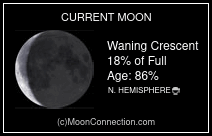
CURRENT MOON PHASE

---------------
1459    AUGUST 4, 2024:   Perseid Meteors Soar This Week
I cannot emphasize enough how the Perseid Meteor Shower played a pivotal role in my decision to pursue a career in astronomy education. It was most of what my cousin, John, and I talked about in the months leading up to the big night and morning of August 11-12, 1964. Luckily, a cold front swept through the area on the afternoon of the 11th. The skies opened at sundown, giving us a grandstand view of this beautiful summer event. Even now six decades later, hoping to glimpse a memorable fireball scorching across the heavens, I still eagerly anticipate the annual Perseid night. * I've come to appreciate that not every year offers ideal conditions for observing the Perseids, with factors such as summer haze, T-storms, and the moon's phases affecting the visibility of meteor activity. This year, the moonset on the evening of August 11 happens before midnight, allowing the best part of the Perseid experience to be witnessed under the darkest conditions in an observer's locale. Next year, a fat-waning gibbous moon lights up the mid-August sky, allowing only the brightest Perseids to be witnessed. However, 2026 is perfect, with a new moon gracing the Perseid maximum evening. * To make the most of your observing experience, gather an air mattress, sleeping bag, pillow(s), flashlight or headlamp (red light), pencil or pen, paper, clipboard, and a tally counter (See Google). Most importantly, do not forget the ground tarp, which enthusiasts should position under your air mattress and over the top of your sleeping bag. If you are on a lawn chair above ground, having your tarp over your chair will be sufficient. I recall very few East Coast Perseid nights where dew was not bothersome. Take your observing location to Utah, Wyoming, Colorado, etc., and you will find dew is not an issue. Keeping yourself and your equipment dry allows for a more comfortable observing experience that will let you see more meteors. * If you are observing with friends, keep conversations to a minimum and leave your earbuds in the charger because the more distractions occupying your time, the fewer shooting stars you will spot. Remember to bring a caffeinated beverage and some light snacks to keep your growling stomach at bay. * For a more scientific approach, consider recording your observations. You can note the number of Perseids with your tally counter and mentally keep track of non-Perseid meteors. Due to Earth's rotation, most meteors will seem to diverge from a point low in the northeast around midnight and transition slowly to a location high in the NE by dawn. Recording these meteors in ten-minute intervals will provide a sufficient resolution to observe the fluctuations in Perseid activity. Make sure to take breaks only during these 10-minute intervals. For more insights into the Perseid Meteor Shower, stay tuned for next week's StarWatch or read ahead below! Ad Astra!
 

1460    AUGUST 11, 2024:   Perseids: Summer's Best Meteor Shower
Monday morning, August 12, will present an exciting opportunity to view the 2024 Perseid meteor shower with minimal moonlight. Moonset occurs before midnight on the 11th. The Perseids are probably the best shooting star event of the year and for good reason. They combine relatively high rates with warm, short summer nights when many individuals are engaged in outdoor vacation activities, such as camping. * Meteor showers result from dust released by comets as they orbit the sun. If a comet's path crosses the plane of Earth's orbit or comes near to it, a meteor shower will be the result. The progenitor of the Perseids is Comet 109P/Swift-Tuttle, which last returned to the sun in 1992 and is expected to debut again in 2125. As a result of its many passages around Sol, debris has been spread fairly uniformly across its orbit, enhancing the reliability of the Perseids to produce a consistent showing year after year. * The best advice for observing is not to start too early in the evening. Midnight is a good target to begin viewing because before that time, the Earth itself shields us from the meteors that we want to see. The analogy is similar to raindrops hitting a vehicle moving through a downpour. The precipitation preferentially strikes the front windshield of the car, while the rear window gets only a little rain because it is protected by the automobile. Likewise in the early evening, we are shielded by the Earth and see reduced meteor activity. As local midnight approaches (1 a.m., EDT), the Earth begins to rotate into the meteoroids, allowing it to sweep up more of these particles. At the beginning of this period, some of the Swift-Tuttle grit will be skimming the top of the Earth's atmosphere. These events can create long, bright trails, sometimes fireballs, as they are ablated (destroyed) more slowly by thinner layers of air. * This year, the Perseid maximum occurs on August 12 between 9 a.m. and noon on the East Coast. This means the period between midnight and dawn on the 12th should provide the highest rates. Rates will drop to about half of what they were on the morning of the 13th. These shooting stars are also brighter before maximum. * Perseids are easily identified because they will appear to diverge from a vanishing point, similar to how a long, straight stretch of roadway seems to narrow and converge at some distant location. That happens because the meteoroid particles, like the sides of the road, are parallel to each other, similar to the comet dross as it orbits the sun. * Perseids will appear to move away from the top of the upside-down, V-shaped constellation of Perseus the Hero. See a map below. Meteor events may appear to bunch or happen in rapid succession. After a bunching sequence, five minutes or more may transpire with no activity. Don't become discouraged. Rates will increase towards dawn with about 25 meteors per hour recorded from suburbia and double that from rural locales. * By midnight, the constellation of Perseus will be entirely above the horizon in the northeast, with the radiant at an altitude of 30 degrees. Orient yourself in that direction, but view near the zenith where the sky is at its darkest, and the ability to witness fainter meteors will be greatest. As the night progresses and the radiant gains altitude, your orientation will not have to change. By 5 a.m., 70 minutes before sunrise, the radiant will be nearing 70 degrees in altitude, but hours before, observers will be able to capture meteors streaming from all directions around the radiant. Observers will see meteor rates maximized in the hours preceding dawn. * Don't forget the warm clothing, sleeping bags, pillows, and tarps to protect yourself against the dew. Caffeinated drinks and snacks will help to keep everyone awake and make your Perseid experience more enjoyable. See last week's StarWatch for more details. Think clear skies mixed with a couple of bright, memorable fireballs! Ad Astra!

[Perseid Radiant]
"X" marks the spot where Perseid meteors will be radiating. Observe after midnight. The constellation of Perseus is oriented for midnight on this map. Gary A. Becker graphics using Software Bisque's The Sky.
 

8-24-aurora-detterline-8-12-24.png
1461    AUGUST 18, 2024:   Read by the Full Moon's Light/Saturn Flyby
As a teenager, I hated the bright moon. It just ruined everything, especially the observation of meteors which was my obsession at that time. Then in the early 2000s, I found myself with high school students on top of Colorado's Mt. Evans, viewing the moon through the 26-inch binocular reflector of the Meyer-Womble Observatory. We were there for the night at the invitation of Dr. Bob—Robert Stencel, observatory director at the University of Denver, to view the moon's vistas at an oxygen-deprived elevation of 14,148 feet. * Looking at the mountains with their jagged, elongated shadows stretching across the barren landscape just after lunar sunrise was a mind-blowing experience for me. Moving the telescope along the terminator of the first quarter moon where the sun was rising, I serendipitously came across Hadley Rille, a sinuous depression that had once carried molten lava across the lunar surface over 3.5 billion years ago, as well as being the landing site of Apollo 15 on August 7, 1971. I recognized it immediately from the NASA images that I had seen. I also realized the folly of my decades-long dislike of the moon, even though I would probably never see a moonscape like that again. It was a watershed moment in my observing life. * How bright is the moon? Try this experiment. Can you read by moonlight? The moon will be full on Monday, August 19, rising in the east-southeast around sunset. Give the moon two to three hours to gain some altitude so its light reaches above the treetops and can shine unhindered in a location where streetlights are shielded. Take along a book, magazine, or newspaper with prints of different sizes on the same page, and give yourself a few minutes for your eyes to adjust until colors can be seen. I predict that you will be able to read the smallest letters by the full moon's light just like my grandfather was able to accomplish when, as a cook on the Russian front during WWI, he read the German newspaper by only the light of the bright winter moon. For me in a dark location like Australia, I could read the letters on my Mt. Washington sweatshirt with only the illumination from the Milky Way Galaxy. * You may want to combine the reading by moonlight experiment with Luna's close passage of Saturn on August 20. At 10:22 p.m., the moon's northern limb (edge) is a scant 1/4-degree from the ringed world. That is only half the angular diameter of the moon. Similar to the lunar occultation of the first magnitude star Spica on July 14, you will need binoculars or a small telescope to catch the scene because the moon's glare will make Saturn impossible to distinguish. Enthusiasts will need a telescope to capture the rings because they have narrowed as the Earth has moved closer to crossing the ring plane of Saturn, making them more difficult to observe. The rings will disappear in March of 2025 and then become faintly visible again for a few months, only to disappear again in November. * Read a book by moonlight and check on the moon and Saturn with binoculars or a telescope on August 20. These are fun observations, allowing you to appreciate the moon's beauty even more. Ad Astra!

[Lunar Shadows]
Long lunar shadows created by the rising sun are easily visible on the north shore of the Imbrium Basin in this stunning image taken by Aerts Leo.

[Aurora on Perseid Morning]
Coming home from an evening of meteor observer, Pete Detterline called to say there was an aurora in progress (top, Peter Detterline). Arriving home around 3 a.m. I was able to get a whisper of the event imaging towards the east. Note the reddish hue on the left side of the image (bottom, Gary A. Becker image).
[Aurora on Perseid Morning]
 

1462    AUGUST 25, 2024:   Saturn Rings to do a Disappearing Act
There are some spectacular objects in the nighttime sky, such as the Ring Nebula, a star that recently came to the end of its life and expelled a circular, nearly perfect "smoke ring" of gas and dust, revealing its dead core which had become a white dwarf. Ultraviolet light from the white dwarf excites the gases of this planetary nebula, causing them to glow, thus revealing the ring. How about its nearby neighbor in the heavens, the Great Globular Cluster in Hercules, M13, with estimates varying between 300,000 to a half-million stars? Globulars represent some of the earliest objects that evolved in our universe. As these massive systems amalgamated into one another during the early, less spacious universe, galaxies may have resulted. * However, nothing can compare to the oohs and aahs of delight when someone views Saturn through the eyepiece of a telescope for the first time. It is just such a spectacular sight. Most novices do not believe that a telescope will easily reveal the rings, but even a good pair of binoculars at ten power will show an elongation to the planet's form. * Galileo drew Saturn that way, calling it oblong ("Saturno hora oblongo") in one of his sketches or in another drawing showing the planet with two moons or attendants, one on either side. Although the refractors he built, the best in the world for the early 17th century, were vastly inferior to today's mass-produced instruments, Galileo never made the connection that the elongations represented a ring system. * That discovery fell to the Dutch astronomer and mathematician, Christiaan Huygens. With a greatly improved telescope and eyepiece that he had constructed with his brother, Constantyn in the spring of 1655, Huygens discovered Saturn's largest satellite, Titan, and resolved the appendages as a detached ring that girded the planet. He explained, as others could not, why the rings disappeared. * The rings that can be easily observed through an earthbound telescope, imaginatively named A and B, vary between 5 to 30 meters in thickness. That is equivalent to 16 to 100 feet in English units. From an Earth to Saturn distance, which varies between 0.9 to 1.1 billion miles, no terrestrial-based telescope can resolve that small an angular measure when the rings become edge-on. So they must disappear. * Saturn's axial tilt and its orbital tilt allow the rings to be observed above and below the ring plane by as much as 26.7 degrees, giving observers magnificent views of the planet's encircling ring system every 13-16 years. Likewise, since Saturn's axial tilt remains essentially fixed in one direction like Earth's axial tilt, Saturn's rings appear to wobble as observed from Earth during its 29.4-year orbital period. When the axis points towards or away from Earth, we witness the rings fully open, either looking down upon the rings if the axis points towards Earth or from below if the axis points away from our planet. A sideways view of Saturn causes the rings to disappear as they will during March of 2025. They will become visible again, only to disappear for a second time in November. That second disappearance will result from Earth's changing orbital position relative to Saturn. * The ring disappearance provides an excellent opportunity to search for more Saturnian satellites to add to the 146 already confirmed. See a series of images depicting the many faces of Saturn's rings and take a look for yourself as the rings do a disappearing act if you own a telescope. Ad Astra!

[Many Faces of Saturn]
The many faces of Saturn. NASA, Hubble and Webb Space Telescope images...
 

[August Star Map]

[August Moon Phase Calendar]
 

---------------