StarWatch for the greater Lehigh Valley
---------------

MARCH  2026

MARCH STAR MAP | MOON PHASE CALENDAR | STARWATCH INDEX | NIGHT SKY NOTEBOOK

[Moon Phases]

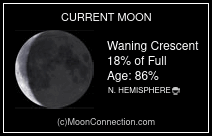
CURRENT MOON PHASE

---------------
1541    MARCH 1, 2026:   A Sunrise Total Lunar Eclipse, Tuesday
If I had to pick a favorite astronomical event, it would be a total solar eclipse. Nothing can be more spectacular than the effects on the ground or ocean and in the sky that accompany the sun's diminution as the moon devours the last thin sliver of its light. The world is plunged into darkness with the sun's radiant corona surrounding the moon. Minutes pass like seconds. * A total solar eclipse can never be long enough. I think part of the added mystique arises from the anticipation of the event—the preparation, the site selection, the travel to the centerline, outsmarting the weather, and a host of other factors that lead up to the moment of totality. Success is sweet. Failure is not an option. * Not as spectacular is a total lunar eclipse, when the full moon encounters and passes completely through the shadow of the Earth. Total lunar eclipses are actually less common than central solar eclipses that include a ring of sunlight surrounding a too small (distant) moon or a total eclipse, the far more spectacular of the two. The Earth presents a larger target to the moon's shadow than the Earth's shadow presents to the moon. The target for the moon's shadow to encounter the Earth for a total solar or annular eclipse is nearly 8000 miles in diameter, but the shadow of the Earth at the moon's distance is about 5700 miles. What is easier to hit, a bullseye of 8000 miles in breadth or one that is only 5700 miles in diameter? The answer is obvious. * So why will most individuals believe that total lunar eclipses are more common than central solar eclipses? The moon's primary shadow cone narrows on average to about 80 miles before reaching the Earth's surface, so unless your geographic location is extremely lucky, you'll need to travel to see a central solar eclipse. However during a total lunar eclipse, anyone who can observe the moon can see the eclipse. Earth's nighttime hemisphere acts like a giant open-air stadium where everyone gets the chance to witness the celestial ballet if the weather cooperates. In addition, some regions of the planet rotate into the eclipse, while other areas move away from the show; so in essence, people living on more than half of the globe get a chance to see the event. * The Northeast is in such a geographic situation because a substantial portion of the lunar eclipse that happens on the morning of March 3 takes place during twilight and after moonset as our location rotates away from the event. The moon sets totally eclipsed, but regions west of us, particularly along the West Coast, get to view the entire event. The eclipse becomes total when the moon is only four degrees above our western horizon at 6:04 a.m., 28 minutes before sunrise. So we rotate eastward away from the eclipse as the moon sets in the west at 6:34 a.m. * I saw a very similar total lunar sunrise eclipse on the morning of August 28, 2007. Hundreds of silent people surrounded me in the cemetery where I was imaging the moon. Near Luna, one cloud was reflecting the first rays of reddened sunlight, as the moon approached its setting position against the treetops of my local horizon. See my photograph here. * On eclipse morning, I'm hoping for high reddened cirrus clouds that could be in sunlight five or ten minutes before moonset, but not be thick enough to obscure the moon. That could create a memorable image. Here are the particulars of the March 3 total lunar eclipse. All times are Eastern Standard.

Moon enters penumbra: 3:44 a.m. The moon is tangent to the secondary shadow of Earth, essentially a non-event.
Dusky effects of penumbral shadow easily seen: 4:15 a.m.
Moon enters umbra: 4:50 a.m. The moon enters Earth's primary shadow. The partial eclipse is underway.
Twilight easily noted, Nautical Twilight: 5:30 a.m.
Stars are gone, Civil Twilight: 6:04 a.m.
Eclipse becomes total: 6:04 a.m.
Sunrise: 6:32 a.m.
Moonset: 6:34 a.m.

Use binoculars to enhance your views of this eclipse, and get ready to be a zombie for the rest of the day. I know that is how I will be. Have fun! Ad Astra!

[Sunrise Eclipse, August 27, 2007]
Clouds just catch the first rays of morning sun near the total lunar eclipse moonset on the morning of August 27, 2007. Gary A. Becker images...

[Sunrise Eclipse, Weather]
Clouds block another interesting eclipse. National Weather Service images...
 

1542    MARCH 8, 2026:   Adjusting Daylight
We passed the winter solstice on December 21, 2025, passed the latest sunrise on January 4, 2026, heard about a late spring from Punxsutawney Phil on February 2, left in the dust the meteorological winter on February 28, and now we are springing ahead into daylight saving time on Sunday, March 8. The next stop on the sun's upward express is the vernal equinox which occurs on Sunday, March 20, at 10:45 a.m. EDT. * This is the time of the year when we all begin to engage in the myth of saving daylight by shifting our clocks ahead by 60 minutes. There will be no 2-3 a.m. on Sunday, March 8, which is excellent news if you are working an eight-hour shift during that period. However, the piper will need to be paid when we fall back an hour on the first Sunday in November. * Many people believe that when we spring ahead to daylight saving time, (no s in saving) the sun goes down an hour later and comes up at the same time or even an hour earlier. That would be called Fantasy Extended Time. What we accomplish by advancing our clocks forward by 60 minutes is to shift our daylight hours more in step with our waking hours. Sunsets occur an hour later about 7 p.m., starting on March 8, but Sol also rises an hour later around 7:25 a.m. on the same day. We have switched our time eastward by one zone to Atlantic Standard, springing forward by one hour. Note that we are still not at the time of equal days and equal nights. That is the concept of the equinoxes, specifically the upcoming vernal equinox, which will be the topic of my next StarWatch blog for March 15. * Daylight saving time was first adopted in Germany in 1916, going into effect from April 30 to September 30 as a means of conserving energy to promote higher production efficiency during WWI. A few weeks later, England and France did the same. In the US, the Daylight-Saving Act of 1917 went into effect in 1918 from the last Sunday in April to the last Sunday in September. Currently, the time parameters are from the second Sunday in March to the first Sunday in November. * After the war, states were allowed to adhere to or ignore the policy, but it became official again in WWII under the synonym of War Time. England went a step further and introduced Double Summer-Time, with the sun setting two hours later after 11 p.m. in London around the summer solstice, again to boost war production even further. * In the US after WWII, states' rights won over again, allowing each state to make changes unencumbered by the federal government. That changed when Lyndon Johnson signed the Uniform Time Act of 1966. Hawaii and Arizona, except for the Navajo Nation, do not observe daylight saving time. US territories that remain on standard time year round include American Samoa, Guam, Northern Mariana Islands, Puerto Rico, and the U.S. Virgin Islands. * I would heartily support congressional legislation making daylight saving time the national standard, extending evening hours at the expense of the morning sun. Nineteen states have passed legislation to do the same, but congressional approval is needed for this to go into effect. Would this enactment reduce energy costs? The answer is most likely no because the extra hour of sunlight gained with later sunsets is taken from the morning hours, when most people are also awake. Still, I champion extending daylight hours in the evening at the expense of morning light. It seems like a better balance of sunlight during our most productive hours. Happy daylight saving time starting now! Another milestone reached and passed on our way to the summer solstice. Ad Astra!
 

1543    MARCH 15, 2026:   Sun rapidly on the Move UP
We passed the winter solstice on December 21, 2025, passed the latest sunrise on January 4, 2026, heard about a late spring (boo) from Punxsutawney Phil on February 2, left the meteorological winter behind on February 28, and sprang ahead into daylight saving time on March 8. The next stop on the sun's upward express is the vernal equinox which occurs on Friday, March 20, at 10:45 a.m. EDT. * After the winter solstice the sun's direction of motion for the Northern Hemisphere is up. Because the Earth's equator is tilted 23.5 degrees from the plane of our orbit, the sun's motion resembles a curve against the stars, with a high midday altitude at the summer solstice and a low point at the winter solstice. These high and low positions cause the sun to linger for months with very little shift in its altitude at noon. For example, the sun's midday height on November 15 in the Lehigh Valley was about 31 degrees. It bottomed out at the time of the winter solstice at 26 degrees above the horizon at noon and did not reach the same altitude at noon of 31 degrees until January 26. That represents a period of 72 days where the sun's energy distribution on the ground was minimal, and the duration when the sun was above the horizon shortened. The sun has dipped by five degrees to its nadir at the winter solstice and recovered by the same amount 72 days later. No wonder it gets cold. * If an equivalent length of time, 72 days, is added to January 26, the sun steadily climbs during that interval to a midday high of 53 degrees, a 22 degree increase. Add another 72 days, and Sol is nearly at its maximum summertime altitude of 73 degrees, another climb of 20 degrees. * You might have already guessed that the vernal equinox is the time of maximum change in the sun's upward climb to the summer solstice and presents the greatest change for an increase of daylight. However, it will still take time for the Northern Hemisphere to adjust its temperatures into line with the sun's rising altitude and higher energy absorption. That occurs in May, when our location warms up sufficiently after winter’s energy deficit. After this past winter, I'm definitely looking forward to spring happening this week. No more snow, please! Ad Astra!

[Changing Position of the Sun]
Gary A. Becker slide...
 

1544    MARCH 22, 2026:   Venus Heralds Spring
Have you noticed an unusually bright star near the western horizon, 30 minutes after sundown? It shines on and off through my neighbors' distant ash trees, almost like a blinking light, as the Earth's rotation carries it closer to the horizon. That is the planet Venus, goddess of beauty, becoming more conspicuous in our spring sky. What makes a springtime apparition of Venus, Mercury, or the moon more noteworthy is the tilt of their orbital paths relative to the horizon. * When our solar system formed 4.5 billion years ago, the contracting clouds of gas and dust from which our sun and planets coalesced were flattened into a plane as the cloud's rotation increased. Today, astronomers refer to this plane as the ecliptic, the plane of Earth's orbit projected into space. It governs the yearly positioning of the sun against the background of the stars. * Because the Earth's axis is tilted 23.5 degrees to the perpendicular of the ecliptic, the Earth's equator is skewed by the same amount to the ecliptic. This causes the sun to move north and south of the equator, giving us our annual seasonal variations. * During the spring when the sun is rapidly gaining altitude in the Northern Hemisphere, the angle that the ecliptic makes with the western horizon is steepest. Fast-moving planets like Venus and Mercury, and our natural satellite, the moon, rapidly gain elevation as they move away from Sol because they are also very close to the plane of the ecliptic. During autumn, the ecliptic is at a very low (oblique) angle to the horizon. Mercury, Venus, and the moon pull away from the sun at their same rates, but their increase in altitude is minimal because of the shallow angle of the ecliptic to the horizon. After sunset Earth's rotation (spin) rapidly brings these objects into a setting position, keeping them invisible to the average observer for longer periods even as they pull away from the sun at the same angular rate. * To illustrate the effects of an ecliptic tilted at a steep angle to the horizon, let us look at Venus' current change in altitude at sundown with respect to the angular departure of Venus from the sun (its elongation).

March 15:    16 deg. alt./16 deg. elongation
March 30:    18 deg. alt./20 deg. elongation
April 15:      21 deg. alt./24 deg. elongation
April 30:      23 deg. alt./28 deg. elongation
May 15:       25 deg. alt./31 deg. elongation
May 18:       Venus at summer solstice
May 30:       27 deg. alt./34 deg. elongation
June 15:      27 deg. alt./38 deg. elongation
June 30:      26 deg. alt./41 deg. elongation
July 15:       24 deg. alt./43 deg. elongation
July 30:       21 deg. alt./45 deg. elongation
Aug. 15:      18 deg. alt./46 deg. elongation
Aug. 30:      15 deg. alt./45 deg. elongation

Note how the high inclination of the ecliptic during the spring causes Venus to gain altitude rapidly, even though its elongation from the sun is not that great. However, once Venus has reached the sun's summer solstice position, its angular distance (elongation) from Sol continues to increase, while it begins a slow descent in altitude as it moves southward along its orbital path towards the sun's winter solstice position. This is not the complete story, but it shows that elongation from the sun does not necessarily determine an object's altitude above the horizon. The tilt of the ecliptic at the location of the planet must also be taken into consideration. Enjoy Venus’ rapid assent occurring at the present time. Ad Astra!


1545    MARCH 29, 2025:   Time Dilation

[Time Dilation]
Gary A. Becker slide...
 

[March Star Map]

[March Moon Phase Calendar]
 

---------------