StarWatch for the greater Lehigh Valley
---------------

OCTOBER  2026

OCTOBER STAR MAP | MOON PHASE CALENDAR | STARWATCH INDEX | NIGHT SKY NOTEBOOK

[Moon Phases]

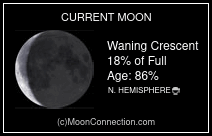
CURRENT MOON PHASE

---------------
1573    OCTOBER 4, 2026:   Early Bird StarWatch
I was going to title this StarWatch something like For the Dawn Blazers or perhaps Crazies to be more succinct, because if you know me, I am not exactly an early riser. However, my wife interjected with, "How many more readers do you want to lose?" * My circadian rhythm, the natural internal clock that follows my 24-hour cycle of waking and sleeping gets me to bed very late, normally 2-3 a.m., and rising between 10 a.m. and noon, so perhaps I am the oddball here. I choose this sleeping pattern because of my interests in observational astronomy, and I have followed this routine since leaving public education in 2010. Under clear skies, I witness events that occur into the morning hours when I am imaging the sky, but seldom at dawn. * That revelation of going to bed so late would drive my Moravian University students up the wall. Enough of them had 8 a.m. commitments that I could hear audible groans in class from the not so morning people forced to rise and shine with the sun. The learners involved in sports got up even earlier, sometimes before 5 a.m., to grab breakfast, and then go to practice before classes began. Toothpicks normally supported their eyelids by the time my 6:30 p.m. astronomy class commenced. Still, they also had the opportunity of witnessing many of the dawn apparitions that I had discussed in class, and to my surprise, many of these people took a quick skyward glance when heading out of doors for breakfast or training. By then, I was drifting hopefully into REM sleep. So for the dawn trotters, or better yet the traditionally normal people who are awake by dawn, here are this week's parade of astronomical happenings. You should be poking your head outside by 5:45 a.m. locally, 5 a.m. in any time zone.

Sunday, October 4, 4-6 a.m.: Moon near Gemini Twins, Castor and Pollux. Normally, Luna's luminescence would wash away even the brightest stars of the Gemini Twins, Castor and Pollux, when nearby, but this morning the waning crescent is only 1/13th its full-moon brightness, allowing both stars to be observed easily with the unaided eye. As in all cases, binoculars will enhance your views because they collect dozens of times more light than the human eye. Look for the moon high in the southeast.

Monday, October 5, dawn: Mars and the moon. This morning a thinner, less bright waning crescent moon, 23 times fainter than its full moon counterpart, confronts the god of war, Mars, at a distance of only three degrees in the eastern sky. Less than one degree below the moon is M44, an old but bright open cluster also known as the Beehive, containing about 1,000 gravitationally bound stars. About 40 or 50 luminaries are visible using binoculars. From rural locales, this cluster is easily visible to the unaided eye, but not from suburbia. Mars is close by and rendezvous with the Beehive next week.

Tuesday, October 6, dawn: Moon and Jupiter snuggle. I may even stay up for this one. The thinning, waning crescent moon is just over 1/50th as bright as the full moon. Jupiter is positioned just over half a degree from the moon's eastern limb. Look toward the east, slightly under mid-sky, for this beautiful sight, which will dazzle the eye and look even better in binoculars. Try an image with your smartphone, especially as the sky begins to brighten with a rosy red glow.

Wednesday, October 7, dawn: Moon near Regulus. Leo the Lion hosts a skeletal, crescent moon low in the east as it departs from the brightest star of the Lion, Regulus, located above the moon. Look for earthshine, the reflected light coming from a nearly full Earth illuminating the unlit portions of the moon. Observing the moon with binoculars will make seeing earthshine a no brainer.

All the best for your successful observations of these celestial events this week. I'll most likely still be in bed. Ad Astra!


1574    OCTOBER 11, 2026:   Mars Disturbs the Beehive this Week
This week highlights a multi-day morning apparition involving Mars and the Beehive star cluster, also known as Messier 44 (M44) or the Praesepe (Latin for manger/I>). It is best viewed at dawn, 5:45 a.m. at the latest for the Lehigh Valley, and 5 a.m., a safe bet for positions in all time zones. The Beehive is located in Cancer the Crab, the most visually obscure constellation of the zodiac, considered one of the 12 star patterns the ancients watched as the sun traversed in front of them over the course of a year. * The paradox is that the Beehive is one of the most easily seen and recognizable grouping of stars in the heavens, visible with the unaided eye from rural locales and singled out by ancient astronomers. It has about 1000 gravitationally bound member stars. The beehive name comes from the cluster's brightest area near its center, which looks like a sideways hive. See an image of the Beehive that I recorded this past spring from my backyard. The other fainter stars of the cluster represent the bees swarming around the hive. Open clusters normally contain dozens to thousands of stars born about the same time. They are transient phenomena. They form from large interstellar gas and dust clouds that occupy the arms of pinwheel-shaped galaxies like our Milky Way and throughout younger, irregular galaxies, island universes with no specific shape. * Open clusters evaporate over time, depending on the strength of the gravitational attraction among their stars. The outer luminaries eventually stray from the fold to begin orbiting the galaxy independently with their retinue of planets and other matter, as our Sun did billions of years ago. This process of losing stars causes the cluster to expand because of a reduction in its mass and gravity's decreasing ability to hold its stars together. The gravitational tugs and pulls of nearby non-cluster stars cause more cluster stars to stray from the fold until the cluster is dispersed completely. The Beehive is relatively close to us, about 600 light years distant, but older than most open clusters, at about 600 million years of age. * On October 10 Mars will be positioned at the western boundary of the Beehive, at the one o'clock position if observing with binoculars. By the 11th, Mars transits across the center of the cluster near the formation of the sideways hive, arriving by the 12th at its eastern boundary near the 6:30 position. Binoculars will be necessary to make this observation. Look east no later than 5:45 a.m. You'll see a long train of bright stars and planets stretching from nearly the zenith to the horizon. The lineup will include Capella, the brightest star in Auriga the Charioteer; Castor and Pollux, the two heads of the Gemini Twins; reddish Mars in the Beehive, followed by brilliant Jupiter, which will dominate the procession, and finally Regulus the Rex (Latin for king), star of Leo the Lion. The reddest "star" of the lineup will be Mars above Jupiter. * The next time Mars mingles with the Beehive is on September 16, 2028. In this configuration, brighter Venus will be a substitute for Jupiter, and the eight percent waning crescent moon, with plenty of earthshine, will anchor the chain near the horizon. Here's looking forward to two great events, this week and in two years. Ad Astra!

[Mars Disturbs the Beehive]
This maps shows the lineup of bright stars and planets which should prove helpful in locating Mars and the Beehive cluster. Binoculars or a small telescope will be necessary to observe the event. Map generated through Software Bisque's The Sky; inset photo of the Beehive, Gary A. Becker...
 

1575    OCTOBER 18, 2026:   Good Year for the Orionids
 

1576    OCTOBER 25, 2026:   
 

[October Star Map]

[October Moon Phase Calendar]
 

---------------