StarWatch for the greater Lehigh Valley
---------------

SEPTEMBER  2026

SEPTEMBER STAR MAP | MOON PHASE CALENDAR | STARWATCH INDEX | NIGHT SKY NOTEBOOK

[Moon Phases]

CURRENT MOON PHASE

---------------
1569    SEPTEMBER 6, 2026:   Ruins Teach a Lesson
The universe is 13.8 billion years old. Keep that thought in mind as you read this article.

I just returned from a very enjoyable 14-day Mediterranean cruise with my friend, Peter Detterline. We added two additional days in Lisbon, Portugal, to begin our journey and three days in Athens, Greece, before returning stateside. * Despite all of the political turmoil that the world is currently experiencing, and to which the US is a principal player, we were treated with friendliness and respect wherever we went. An acquaintance warned me about how poorly Americans were being regarded by Europeans and advised that anyone currently traveling abroad was just plain crazy. I also read articles warning about how pervasive pickpockets were in Barcelona, Spain; Rome, and Athens, and I took precautions, but again we had no bad experiences anywhere we traveled. My belief persists that nations may treat each other crudely, but people from different cultures and religious beliefs are normally cooperative, with a genuinely welcoming attitude. * The one aspect of southern Europe that I found unexpected was the graffiti that could be found almost everywhere. No one really seemed to mind it as an eyesore, and no one seemed to want to eliminate it. Locals accepted it as part of their visual landscape as they went from place to place. * However, what made a lasting impression on me were the ruins, the forts in Lisbon, Portugal; Barcelona, Spain; and Bari, Italy. They were built, destroyed, rebuilt, remodeled, wrecked again, forgotten, and are now being restored at great expense as tourist attractions to highlight the regions' histories. Walking through the Roman Colosseum and Forum reminded me of the suffering that humanity endured to fuel the greed of emperors while simultaneously feeding the public entertainment. In Athens, the distant Parthenon stood tall and proud, perched overlooking the Acropolis. Still, when I walked up the hill along a polished, sometimes slippery path of ancient stones, newer macadam, and concrete, it looked shabby and worn up close from a gunpowder explosion that virtually destroyed it in 1687 during the Morean War. It has been under continuous reconstruction since 1975, yet the Parthenon still remains a ruin. Ironically, all of its building and decorative artwork took only 15 years to complete in the fifth century BCE. * Peter asked me which one was more impressive, the Colosseum or the Parthenon? I leaned toward the Colosseum because of its complex infrastructure, but it was not a black-and-white decision. * What impressed me the most was walking in and around St. Peter's Basilica. Although not a Catholic, I am positive that part of my feelings were generated because I considered this site to be the seat of my Christian beliefs. Enhanced and maintained by some of the greatest artists, builders, and thinkers of the Renaissance and modern era, here was a magnificent tribute to human creativity preserved for all faiths to witness. The Roman Emperor Constantine established the first church at this site between 318 and 326 CE, but it was also systematically demolished during the 16th and 17th centuries to make room for the Basilica. * Humans have been building, destroying, and rebuilding their worlds for at least 9,000 years and fighting among each other since Adam and Eve. Suppose we could suppress our petty differences, our greed for money and power, our desire to have it all; what a beautiful world this could become! * The truth is that in the folly to be remembered, we will all be forgotten, yes all of us. I'm not happy with that thought, but I'm content in knowing that no one gets a break from eventual obscurity. Species only exist for finite amounts of time. However, if we all pulled together around the basics of truth, compassion, justice, equality, and sustainability, we might be remembered collectively as a group that tried its best for the common good. I'm not suggesting that everyone begets the same amount of wealth. Enterprise should be rewarded in a free society. I'm just suggesting that everyone play by the same rules. That would be enough for me. * Since the Big Bang, the origin of our universe, during the 0.00006522 percent of the time that humans have been actively sculpting their world, we could have done better. That is what this trip taught me in a very graphic way. Humanity's goal should be to do better for all of its members. Find pictures below. Ad Astra!

[Roman Colosseum]
The Roman Colosseum and Parthenon, both tributes to human engineering and inovation and both in ruins. Gary A. Becker photography...
[Parthenon]
>

[St. Peter's Baldachin]
The Baldachin under which the Papal High Altar sits and dome in St. Peter's Basilica in Rome... Gary A. Becker photography

1570    SEPTEMBER 13, 2026:   Now You See It; Now You Don't
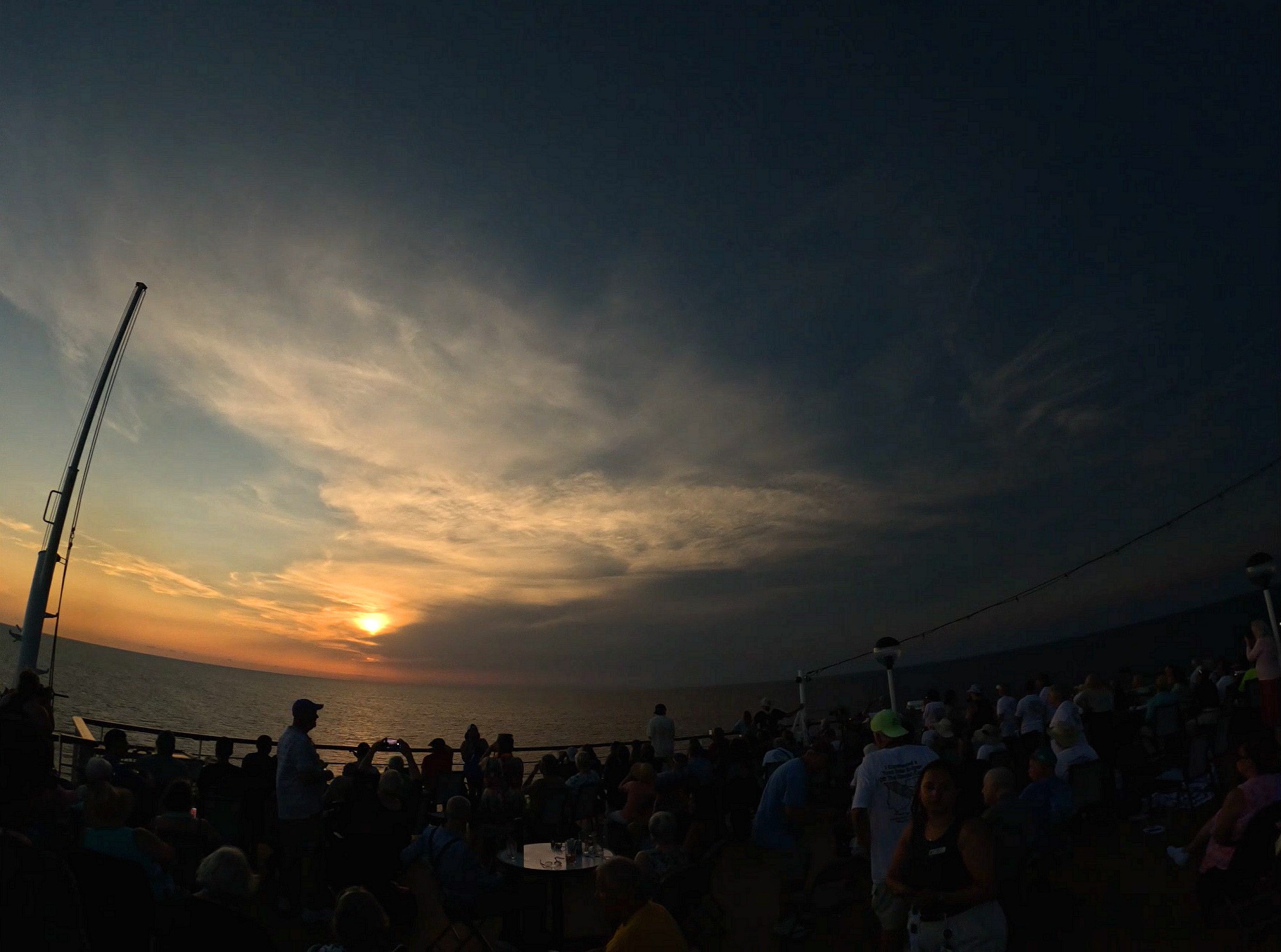
Last week, I spoke about my personal experiences on a Mediterranean cruise through southern Europe, sponsored by the Holland America Line. Good service, great food, and enjoyable tours in some of Europe's most popular coastal towns and cities made it a worthwhile experience. I honestly became "all ruined out" from the many ancient and Medieval structures I had seen, but it was fulfilling to hit numerous bucket-list locales like Rome and Athens. Along the way, I hoped to witness a total solar eclipse. * By chasing eclipses, you get a chance to see the world because during a normal lifetime, the moon's thin shadow will sweep across most areas of the globe while missing most specific locales in those regions. By having a broader worldview than just relying on the eclipse, a backup plan can be created to ensure a successful trip if poor weather prevents the eclipse from being seen. That backup plan, a Mediterranean cruise, made this vacation a success because clouds hid the sun during totality. Sol did not reappear until about 13 minutes after the main event. Still, it was not a complete failure because Pete Detterline's spectacular video revealed the moon's shadow racing across the clouds during the pre- and post-totality moments. See his movie below. My role was to image the eclipse in stills with a telephoto lens and catch the magnificent corona in greater detail. Obviously that did not occur, but the reddened sun setting into the Mediterranean Sea with a major chunk of the departing moon still occulting its surface was a spectacular sight. * So what actually went wrong, since another cruise that friend, Terry Pundiak and his wife, Carol, were taking saw the corona, albeit through high level clouds. Evidently, the captain of the Oosterdam, Wouter van Hoogdalem, was ill-advised about chasing eclipses, or perhaps, in a kinder scenario, Holland America wouldn't let him deviate from his course. One person lamented that van Hoogdalem mixed up his contact times, thinking first contact was the beginning of the eclipse and second contact the end, when in effect it was the beginning of totality. In this shortened version of the eclipse, totality would have been visible above the clouds. * However, other issues came into play because the Master of the Oosterdam positioned his ship's stern so that it was facing towards the eclipse, allowing large areas of the vessel with shaded, wind-abating windows to have poor visibility of the event. About three or four kilometers away, another cruise ship faced its port side eclipse-ward, maximizing deck space and allowing a significant percentage of its passengers to view the near-sunset event from their stateroom verandas. * The rumor here was that the Oosterdam did not have stabilizing gyros so it needed to be faced into the wind. However, the Mediterranean was very calm on E-day, and large vessels like the Oosterdam do not use gyros for stability; they use fin stabilizers which are much more effective at calming a ship's motion. * The only conclusion that I can reach is that van Hoogdalem was inappropriately prepared through his own research or by others. Had the ship been 20 or 30 nautical miles farther south, the clouds that obscured the sun during totality would have been above the eclipse, allowing the corona to be seen. Ten to 15 miles to the west and we would have most likely missed the main cloud bank. A much better position would have been just west of Majorca, several hundred kilometers south of our location. * When I escorted groups on eclipse cruises, I made it a point to talk with the members of my contingency to hear their thoughts. For the February 26, 1998 eclipse off the coast of Aruba, I spoke with someone in a command position to suggest how the crew could better prepare the ship for the event. I remember the individual was an eager listener. He agreed to a dozen suggestions that my group proposed to improve visibility for its passengers. In another eclipse off the coast of Hawaii in 1991, I was invited to have dinner with the captain. I don't know if Insight Cruises, the company Pete and I signed with made any suggestions to van Hoogdalem, but I am confident this eclipse would have been seen if the ship's Master had had been better informed. I am also equally confident that high clouds would still have been present, but the corona, which makes a total solar eclipse so spectacular, would have been easily seen during totality. Ad Astra!

[Sunset Eclipse]
Totality would have been visible just a few miles away. Pete Detterlines still (below) from a video he made shows just how close we came to seeing this eclipse. Gary A. Becker photography...

Click to watch video
Click on the picture to view Peter Detterline's video of the August 12, 2026 total solar eclipse at sea, south of Barcelona, Spain.

[Eclipse Sunset]
Sunset, with the moon's silhouette provided some solace for a cloudy totality. Gary A. Becker photography
 

1571    SEPTEMBER 20, 2026:   On the Cusp of Autumn
After summer's freedom, September was always a letdown for me. I loved teaching astronomy, working with students who were on the cutting edge of life, and discovering new information or a different way to present a concept. However, grading papers and establishing a routine were more difficult, but I fell into the routine. Now that I am retired after 54 years in the profession, I do miss the interaction with students. However, I am reveling in the fact that my routine is more flexible, and if clear weather beckons, I can stay up all night if I choose. * A significant part of September's back to work feelings were knowing that daylight, the sun, and the leaves were all contracting or falling at a faster and faster pace. The time of greatest change was from mid-September through early October. The day the sun makes its greatest downward slip occurs on the autumnal equinox, the balance point between the solstices, when the sun is the highest and lowest in the heavens. The sun reaches its midpoint in its annual journey at 8:07 p.m. EDT, September 22, the time of the autumnal equinox. However, there is also some positivity here. The greatest stretch of pleasant weather from late September through late November is unfolding. * No surprise that 2026 was the hottest summer on record according to climatologists, so even with the diminution of daylight created by a much lower, sinking sun, it takes time for the mid-latitudes to cool adequately. Couple that with a super El Niño weather pattern that generally creates warmer conditions for the mid-Atlantic, and we may even hold back winter for a few extra weeks. The downside of an El Niño fall and winter is wetter, stormier tracks for low-pressure systems, and when winter finally sets in, conditions become enhanced for major snowfalls from coastal Nor'easters. * By the time of our winter solstice on December 21 at 6:49 p.m., EST we will have lost just under six hours of sunlight from the maximum 15 hours of sun experienced at the time of the summer solstice. * One final note about the equinoxes. Even though the word means equal nights and suggests day and night are the same length, that condition is not exactly true. According to the US Naval Observatory, that will not happen until September 26 for 40 degrees north latitude. Several factors create this apparent discrepancy. First, the Sun is not a point source of light; it has a physical size (about the same as the Moon) when observed in the sky. Therefore, it takes time for the sun to rise and set. Sunrise is defined as the instant when the leading edge of the Sun's disk becomes visible on the horizon. In contrast, sunset is the instant when the trailing edge of the disk disappears below the horizon. Furthermore, the atmosphere bends the path of sunlight, making Sol appear higher in the sky by 34 minutes of arc (slightly greater than a half degree), than it would be seen if Earth had no atmosphere. This is termed astronomical refraction. The combination of the Sun's physical size and the effects of astronomical refraction extends the sun's light by two extra minutes from its actual rising and setting times at our angular distance north of the equator. That's four minutes total. It's a small victory for those of us who enjoy light over darkness. Ad Astra!
 

1572    SEPTEMBER 27, 2026:   StarWatch at 30
 

[September Star Map]

[September Moon Phase Calendar]
 

---------------